Friday, September 27, 2013

Eisenhower GTD and MTR at hour-of-power

As the tasks got more and more during the last years I started reviewing and testing all kind of time and self management techniques to find the most suitable ones for me. Eventually I came up with a set of several different methods combined to a whole management strategy.

Base of my task management are the key principles of Getting Things Done (GTD) by David Allen. To my understanding these are:

  • what comes to your attention as a task is in your "inbox"
  • tasks that require less than 2 minutes should be done immediately
  • sort everything else from your inbox to an appropriate task list
  • make different lists for different task types
  • put together your daily schedule from the different task lists
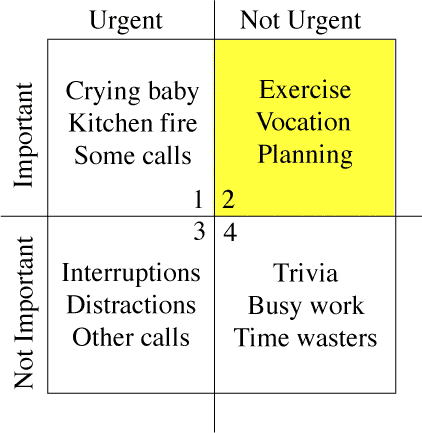
Next comes in the Eisenhower matrix. This principle divides all tasks into four categories related to how urgent and important they are (see graphic from Wikipedia). These categories now make up my GTD task lists. Every morning I select a limited number of tasks from the two "important" lists and put them in my daily planning. However, though GTD is a rather strict system and requires a certain level of self discipline, David Allen also recommends to use gut feeling to be productive. Hence, sometimes I feel more comfortable with doing an "urgent - not important" tasks, which is commonly regarded as self deception.

The problem with urgent and important tasks is that they often became urgent because of being unattended for so long. When I finally get to work on them I generally have to start from scratch - with limited time. But its very much easier (for me at least) to start things without pressure and continue occasionally. Hence, I always try to initially work approx one hour on tasks when they are still "not urgent". I call this "make things running" (MTR). In my daily planning the MTR schedules are usually located in the morning, when concentration is high and distractions are low. This "hour-of-power" principle is a common mangement technique, especially regarding tasks that have piled up for too long.

To organise this system on my computer I am tagging all incoming tasks according the Eisenhower categories. Emails are tagged using the respective function of my email client, files are tagged in the very useful file management tool "Nemo Documents" "tabbles" (Nemo unfortunately got discontinued, and tabbles evolved from version 2 to be way better than Nemo) and any thoughts, ideas and reminders are stored and tagged in Evernote.

I also tried the Pomodoro technique which slices tasks into several time blocks of twenty to thirty minutes, with five minutes intermissions. It fits easily into the strategy described here. However, I didn't find it useful for me.


Are PAH from coals ecotoxicologically relevant?

We just put out a paper in the journal Environmental Science & Technology about "Limited waterborne acute toxicity of native polycyclic aromatic compounds from coals of different types compared to their total hazard potential".

Wiebke Meyer of the University of Münster, Germany, has done part of her PhD thesis in our labs. She tested different types of coals for their toxic potential due to the contained natural PAH. Effects were recorded for extracts as well as the native coals samples using nematodes and zebrafish as test organisms.
Whereas the extracts - representing the overall hazardous potential - gave strong effectiveness in both test systems, no toxicity of the native samples was found, and thus the bioavailable contaminant fraction. Importantly, the results were independent of coal properties.

Find the publication here.

Friday, September 06, 2013

Micronucleus assay goes robotics

In future our micronucleus assay (MNC) will run semi-automatically using a slideloader and a software-controlled automatic stage attached to a fluorescence microscope with a camera. Together with Nikon GmbH and Prior Scientific Instruments GmbH we successfully tested this combination as a measure for a dramatic increase in sample throughput of the MNC. Furthermore this allows to have well documented MNC results. For several cell types also a software-based evaluation should be feasible.

The equipment is the most recent addition to the high-end technology facilities in our Students Lab Fascinating Environment. Nikon as well as Prior are partners of this fruitful academia-industry initiative. We also produced a movie clip showing the equipment at work. I will link it here soon.

Monday, August 19, 2013

Research interest

The work group researches effect-related ecotoxicology with a strong focus on biotest development and optimisation. Our main research topic are polluted soils and sediments with the aim to contribute to a reliable risk assessment. Since 2010 the group works on passive sampling and passive dosing approaches. Here we aim to integrate both concepts in an experimental strategy that also allows for high sample throughput.

We are active in increasing the perception of environmental sciences by the general public. This means to work on tailor-made concepts for science communication, to push the discussion about deficits and future chances at conferences as well as through journal articles, and to run modern public relations.

Career logo design


During the years I happened to design several logos. All started with the one for the EULIMNOS project and since then I took every opportunity to create more. Here's a gallery of my works. :-)

EULIMNOS project
SETAC Europe Student Advisory Council

Work group logo (yet unofficial)
Students Lab Fascinating Environment
Illustration for "Erfahrungsbasierte Forscherwerdung" in unigestalten
http://www.unigestalten.de/component/unigestalten/item/142.html

Tox-Box joint research project
Joint DFG Project PASSEDOble
Project proposal COMPASS
BioEDando internal workshop
W3-Hydro joint research project
Project proposal Hyprotox
Project proposal biobaSE
Softskill course "Students going scientific"


Students Lab in-house exhibition "Biological Advent"

Proposed logo for project TEPHA
Proposed logo for project DEMO3 AC
SETAC Advisory Group on science and risk communication
Project proposal BioEffecTools
Project proposal IDEFIX
EU H2020 project GRACE
Project proposal PROgRESS

Dioxin-like activity of passive sampler extracts

Recently we did a very nice collaboration work with Dr. Emmanuel Emelogu of Robert Gordon University in Aberdeen in the framework of his PhD thesis. He sampled freely dissolved concentrations of hydrophobic organic contaminants in Scottish estuaries and tested the extracts at our labs using a specifically adapted RTL-W1 EROD assay in 24-well plates. Comparison of the biological activity with the chemical analysis data revealed that the majority of effect could not be attributed to the detected pollutants. Find the full article here.

Paper series on science and risk communication

Earlier this year I started a paper series on science and risk communication as an editor in Environmental Sciences Europe. The series will publish a wealth of articles on a broad range of different cases of communication in environmental sciences. It is meant to facilitate the discussion about science and risk communication we initiated with a session at the SETAC World Congress 2012 in Berlin.

Six to eight contributions are confirmed and three of them were already submitted or published. However, the call for papers is still open. Whoever wants to add a manuscript should contact me by email. The up-to-date content of the series including the editorial with additional information is accessible here.