I am not going to make a political statement here. Democracy in general, the principles behind, the benefits and difficulties of having a majority-driven decision process, and the sacrifices we all have to accept to make democracy a working concept, are beyond politics. They are beyond beliefs and opinions, beyond political directions and parties...and ideologies.
However, for democracy to work that way and being able to resist attacks from undemocratic sources (whatever they are and whereever they come from), everyone participating in democratic processes needs be able to make well-informed decisions. It's not what we believe that should lead us in democracy, its the facts. Its not our opinions that should steer us towards a certain decision, its the facts. It's not our political home or party that should motivate us to have our say on a given topic, it's the facts. And it's by far not ideology that should control how we shape the future of our societies - but the facts.
Facts are what we initially perceive as the truth after stripping off all misunderstandings and misinterpretations. Facts is what remains after we took a scientific look at what we first saw, heard, felt, and thus, believed. A scientific look. A look that questions what we perceive, that takes different perspectives and includes views from different angles. A look that challenges our intial, shallow treatment of what we readily understand as the truth. A look that provides enough scepticism to let common sense shine through and help avoiding traps.
This is how scientists work. They have a hypothesis, a certain belief. Then they design experiments to test that hypothesis. Of course, since it is their belief in the first place, the experimental design is biased. You cannot design an experiment without an expected outcome. By means of the experiments scientists generate data. And these they interprete. They ask the data against the background of all the knowledge available so far: what are you telling me? Their interpretation has to stand against everything that is known about the specific topic, and it has to fit in this knowledge to advance it. Or it has to disprove the current knowledge with sufficient evidence, which is - of course - also backed by a body of other knowledge where the findings fit into.
Working scientifically means to not take a first impression as the truth, but to dig deep into any issue, until finding the core of it. This core is the fact to build an opinion that leads to a belief. While scientists are rather good at this exercise in the laboratory or whereever they work, today's world could use quite a bit scientific thinking outside the ivory tower.
Currently, nearly any political debate in any country seems loaded with more non-scientific or even pseudo-scientific reasoning then maybe ever before in history. Statements and claims are just made, with no evidence given, no proof provided, no proper arguments presented.
When the president of the United States tweets that everybody thinks he is doing a great job and that no president before him accomplished as much as he did so far, where's the scientists asking who "everybody" is, whether he refers to the world, the USA, Washington, the White House? Where's the scientists demanding proof in the form of polls, quotes - facts? People might see this as trivial, believing that everybody should know it is nonsense. But a significant fraction of the American people believe this. If it remains unchallenged, it seems sort of proven. Otherwise people who know better would speak out, wouldn't they?!
When in Chemnitz, Germany, thousands of extrem right-wing, antimuslimic, racist and neo-Nazi people together with the AfD party protest against a homicide allegedly committed by refugees, because the victim was - at least partly - German, and the state premier of Saxony, Michael Kretschmer, downplays this as only a harmless commemoration march, where's the scientists pointing out that in 2017 405 persons were murdered, without thousands of people taking to the streets? Where's the scientists challenging Kretschmer in asking what he believes why strangers from all over the republic suddenly feel compelled to mourn about this dead young man? Where's the scientists asking why the extrem right-wing care about a German-Cuban? That person wouldn't be at all Aryan in their perfect world.
We scientists were trained to think in a particular way and the taxpayer mostly covered the costs for this training. We are meant to form the intellectual spearhead of society, finding and presenting the truth about any scientific question. But we should also find, present and ultimatively protect any truth; by providing the facts, collected through scientific thinking. We are the "elite" that the society has to rely on. If we scientists do not reveal the facts behind any political statement, development or initiative, who does?!
Democracy only works if people can make well-informed decisions. We scientists can make sure that the facts become clearly visible. However, it's then on the people to look at the facts, understand them and draw their conclusion. This requires also the ability for scientific thinking. Only when people understand, why a given fact is the truth, and not so what they initially perceived, they can also accept the fact as the basis of their decision making.
Scientific thinking is not a superpower. It is a specific strategy for looking at putative knowledge and find the shortcomings of the first impression of it - in case there are any. It requires training, because people need to get used to it. Besides this it relies mainly on an open mind, a good portion of scepticism and self-awarenss, and common sense. Hence, we need scientific education already at the early ages.
Consequently, everybody can be a scientist - or better - a scientific thinker. And everybody should be. Not only to be able to better understand and rate the facts scientists had hopefully dug out, but to be able by themselves to strip off all misleading information from the "truth" they get presented. To get to the facts, make well-informed decisions, and make democracy work.
Showing posts with label Misc. Show all posts
Showing posts with label Misc. Show all posts
Thursday, September 06, 2018

Sunday, September 17, 2017
Hopefully back for good
It's been a while since my last post. I probably have lost some of my readership. For the success of a blog, trust of the readers that a new article will appear on a regular basis is vital. Intervals between the updates can differ from blog to blog, but for each blog they should stay roughly the same. Otherwise, the blog might look like being abandoned and people rapidly lose interest. My blog started with the intention to publish new content once a week. Hence, from a communication-through-social-media point of view, I failed.
Here, I'll have a look at the reasons, and use this opportunity to give some insights into the work of a university-based environmental scientist. My case is certainly as unique as any other, but the general work load coming from different areas of activity should pertain to the majority of scientists in a similar position. What I describe in the following should therefore be sufficient as a principle example to understand the circumstances under which scientists at universities do their work.
To put it short: It is much more than just education and research.
For people outside my group or even outside scientific research at a university, it might appear rather feasible to write a half-pager every seven days. But when taking a closer look at a normal day at the office, and taking into account all my tasks and duties, it becomes very clear that 24 hours a day are simply not enough. Besides teaching and research, there are a whole lot of other activities that need regular attention and are also of high importance.
But before coming to these: teaching not only means giving lectures, holding seminars, leading practicals. It starts with the preparation of the material, which should always be up-to-date. Concepts and contents might need to be revised and improved based on the evaluation from last time. Moreover, some formats like practicals also need attention afterwards, when study reports or seminar papers have to be reviewed. And teaching also involves answering questions that appeared after a lecture or the like, either by email or personally during office hours.
Research starts with an idea, which first needs to be validated against the current knowledge. For this, scientists have to review the available literature, which means, they have to read loads of publications and text book content. Reading is one of the main requirements for scientific research, since we always should be up-to-date with the current state of background for a certain topic. Next comes, in the vast majority of cases, the proposal writing. Only a small part of scientific research is done completely independent of third-party funding. Most projects are based on a successful research proposal to a funding body, such as EU or national research foundations of ministries. Once the project is granted and the work started, PhD theses require supervision, including review of paper drafts, regular meetings, and also procurement - the latter of which can take up a lot of time. Finally, networking is crucial for successful research. As a consequence, scientists not only sit a significant amount on the phone of in online conference calls, but also travel a lot; and they have many conversations with colleagues all over the world.
This alone - teaching and research - consumes nearly all time in a typical week. But there is much more to do. I am for instance assistant coordinator for Erasmus and student mobility of the Aachen Biology and Biotechnology (ABBt) at RWTH Aachen University (the School of Biology, so to say). This means I am advising students regarding their opportunities to go abroad, and I am organising the Erasmus process for the ABBt. I am also co-leading the institute's IT team, thus regularly dealing with computer and network issues. Further on, I am managing our Students Lab "Fascinating Environment". This is a very successful academia-industry partnership and requires continuous maintenance, care and development. Since I am very interested in science communication I am also in charge of our public relations activities: website, news, press releases. There's a reason why we are still not active on facebook and twitter - limited time. Last not least, I am controlling most of our project finances. Did I forget something? Yes, I am also a work safety commissioner of the institute.
In addition to all those institute-related activities, I have large a number of tasks and duties outside my primary job description. During the last years I became increasingly involved in SETAC Europe, sitting on several committees and working in a couple of interest groups. This means, regular meetings, most of them online, and specific actions to fulfil. In particular the Science and Risk Communication Interest Group (SCIRIC) requires my continuous attention. As the SCIRIC chair a significant amount of time is dedicated to this interest group, especially in the current state, where we still grow and need to develop in a well-functioning group.
While the institute-related activities are primarily happening during the day, all the tasks more dependent on reading and writing I take on in my free time after kids are in bed. The Friday evening is a particularly productive period, since I can work until late at night. Unfortunately, this was originally meant to be the moment when I write for my blog.
Now, the core question that should come to one's mind is whether all this is necessary and worth it? Not an easy one. Teaching and research are not at issue. So how about the "side activities"?
Before one wonders: No, workload didn't significantly decrease. Rather the opposite. My to-do lists grow bigger and bigger; my high-priority tasks become more and more; deadlines haunt me all the time. But a key principle of time management is to take the time when you need it, instead of waiting to find it. And so I did for this post. Hopefully, it will also bring my blog back to life. Then it was definitely worth it.
Here, I'll have a look at the reasons, and use this opportunity to give some insights into the work of a university-based environmental scientist. My case is certainly as unique as any other, but the general work load coming from different areas of activity should pertain to the majority of scientists in a similar position. What I describe in the following should therefore be sufficient as a principle example to understand the circumstances under which scientists at universities do their work.
To put it short: It is much more than just education and research.
For people outside my group or even outside scientific research at a university, it might appear rather feasible to write a half-pager every seven days. But when taking a closer look at a normal day at the office, and taking into account all my tasks and duties, it becomes very clear that 24 hours a day are simply not enough. Besides teaching and research, there are a whole lot of other activities that need regular attention and are also of high importance.
But before coming to these: teaching not only means giving lectures, holding seminars, leading practicals. It starts with the preparation of the material, which should always be up-to-date. Concepts and contents might need to be revised and improved based on the evaluation from last time. Moreover, some formats like practicals also need attention afterwards, when study reports or seminar papers have to be reviewed. And teaching also involves answering questions that appeared after a lecture or the like, either by email or personally during office hours.
Research starts with an idea, which first needs to be validated against the current knowledge. For this, scientists have to review the available literature, which means, they have to read loads of publications and text book content. Reading is one of the main requirements for scientific research, since we always should be up-to-date with the current state of background for a certain topic. Next comes, in the vast majority of cases, the proposal writing. Only a small part of scientific research is done completely independent of third-party funding. Most projects are based on a successful research proposal to a funding body, such as EU or national research foundations of ministries. Once the project is granted and the work started, PhD theses require supervision, including review of paper drafts, regular meetings, and also procurement - the latter of which can take up a lot of time. Finally, networking is crucial for successful research. As a consequence, scientists not only sit a significant amount on the phone of in online conference calls, but also travel a lot; and they have many conversations with colleagues all over the world.
This alone - teaching and research - consumes nearly all time in a typical week. But there is much more to do. I am for instance assistant coordinator for Erasmus and student mobility of the Aachen Biology and Biotechnology (ABBt) at RWTH Aachen University (the School of Biology, so to say). This means I am advising students regarding their opportunities to go abroad, and I am organising the Erasmus process for the ABBt. I am also co-leading the institute's IT team, thus regularly dealing with computer and network issues. Further on, I am managing our Students Lab "Fascinating Environment". This is a very successful academia-industry partnership and requires continuous maintenance, care and development. Since I am very interested in science communication I am also in charge of our public relations activities: website, news, press releases. There's a reason why we are still not active on facebook and twitter - limited time. Last not least, I am controlling most of our project finances. Did I forget something? Yes, I am also a work safety commissioner of the institute.
In addition to all those institute-related activities, I have large a number of tasks and duties outside my primary job description. During the last years I became increasingly involved in SETAC Europe, sitting on several committees and working in a couple of interest groups. This means, regular meetings, most of them online, and specific actions to fulfil. In particular the Science and Risk Communication Interest Group (SCIRIC) requires my continuous attention. As the SCIRIC chair a significant amount of time is dedicated to this interest group, especially in the current state, where we still grow and need to develop in a well-functioning group.
While the institute-related activities are primarily happening during the day, all the tasks more dependent on reading and writing I take on in my free time after kids are in bed. The Friday evening is a particularly productive period, since I can work until late at night. Unfortunately, this was originally meant to be the moment when I write for my blog.
Now, the core question that should come to one's mind is whether all this is necessary and worth it? Not an easy one. Teaching and research are not at issue. So how about the "side activities"?
- I could quit the mobility thing, but this is among the nicest parts of my job. I am at the university to educate students and help them develop.
- The simple reason why my colleague and I lead the IT team is because we are the two persons at the institute best suited for this. Someone has to do it, otherwise the institute as whole would not function properly - which would also impact my work.
- Our Students Lab needs managing. In my position, this is my job. We could of course end the partnership, but this would heavily impact our education and research.
- With public relations, things are clear: I wouldn't promote outreach through SCIRIC and many other activities if I didn't think it is absolutely worth it. Every single bit of more attention by the different target audiences can help us to improve environmental quality.
- Project finances have to be taken care of. This is a typical task for someone in my position. Larger institutes might have specific personnel for this, but we do not. And this would require additional resources, which would need to be acquired through more fundraising also from my side. So either way, the task eats up time.
- And the SETAC activities? Yes, this doesn't seem necessary in the first place. But our scientific community relies on personal involvement. We are environmental scientists, because we believe that our research can improve or at least maintain environmental quality and thus quality of life. From this idealistic point of view, being active in SETAC helps our mission and so is worth it.
Before one wonders: No, workload didn't significantly decrease. Rather the opposite. My to-do lists grow bigger and bigger; my high-priority tasks become more and more; deadlines haunt me all the time. But a key principle of time management is to take the time when you need it, instead of waiting to find it. And so I did for this post. Hopefully, it will also bring my blog back to life. Then it was definitely worth it.
Tuesday, January 13, 2015
SOLUTIONS post on the freshwaterblog
The SOLUTIONS project held its annual general assembly from 13 to 16 October in Delft, The Netherlands. It was a very valuable event with the cosy atmosphere of a family meeting.
We tried to capture this feeling in a blog post for the freshwaterblog, which is run by one of our partner projects - called MARS.
I enjoyed being responsible for the first draft, and hence the overall structure of the text. It is based on a personal-general scheme, for which I collected quotations from project members. This was fun, especially because I chose a slightly cybernetical approach asking my interview partners about their role in and expectations for SOLUTIONS - sometimes quite a challenge for scientists in times when the main reason for projects seems to be fundraising.
Appears to have been a good excercise for everyone. The blog post can be accessed here.
I enjoyed being responsible for the first draft, and hence the overall structure of the text. It is based on a personal-general scheme, for which I collected quotations from project members. This was fun, especially because I chose a slightly cybernetical approach asking my interview partners about their role in and expectations for SOLUTIONS - sometimes quite a challenge for scientists in times when the main reason for projects seems to be fundraising.
Appears to have been a good excercise for everyone. The blog post can be accessed here.
Thursday, April 10, 2014
Here's to identification!
It took me quite a long time to come up with a satisfying logo for the research group."Effect-related Ecotoxicology" doesn't work well as an acronym. Adding "work group" or "reasearch group" or even "team" as initials also just sounded silly. Well, so the best way out is to avoid using an acronym for the logo. The disadvantage of this strategy is that a catchy group acronym aids in identfication of the members with their research ("Hi, I'm Thomas of the REFEC team!"). But a bird in the hand is worth two in the bush. So here's what I have in hand now. Maybe I find something better in the bushes later on.

Friday, September 27, 2013
Eisenhower GTD and MTR at hour-of-power
As the tasks got more and more during the last years I started reviewing and testing all kind of time and self management techniques to find the most suitable ones for me. Eventually I came up with a set of several different methods combined to a whole management strategy.
Base of my task management are the key principles of Getting Things Done (GTD) by David Allen. To my understanding these are:
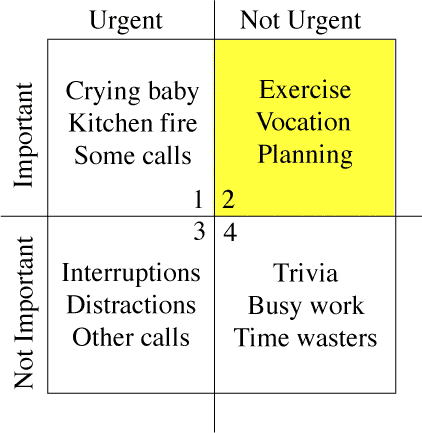 Next comes in the Eisenhower matrix. This principle divides all tasks into four categories related to how urgent and important they are (see graphic from Wikipedia). These categories now make up my GTD task lists. Every morning I select a limited number of tasks from the two "important" lists and put them in my daily planning. However, though GTD is a rather strict system and requires a certain level of self discipline, David Allen also recommends to use gut feeling to be productive. Hence, sometimes I feel more comfortable with doing an "urgent - not important" tasks, which is commonly regarded as self deception.
Base of my task management are the key principles of Getting Things Done (GTD) by David Allen. To my understanding these are:
- what comes to your attention as a task is in your "inbox"
- tasks that require less than 2 minutes should be done immediately
- sort everything else from your inbox to an appropriate task list
- make different lists for different task types
- put together your daily schedule from the different task lists
 Next comes in the Eisenhower matrix. This principle divides all tasks into four categories related to how urgent and important they are (see graphic from Wikipedia). These categories now make up my GTD task lists. Every morning I select a limited number of tasks from the two "important" lists and put them in my daily planning. However, though GTD is a rather strict system and requires a certain level of self discipline, David Allen also recommends to use gut feeling to be productive. Hence, sometimes I feel more comfortable with doing an "urgent - not important" tasks, which is commonly regarded as self deception.
The problem with urgent and important tasks is that they often became urgent because of being unattended for so long. When I finally get to work on them I generally have to start from scratch - with limited time. But its very much easier (for me at least) to start things without pressure and continue occasionally. Hence, I always try to initially work approx one hour on tasks when they are still "not urgent". I call this "make things running" (MTR). In my daily planning the MTR schedules are usually located in the morning, when concentration is high and distractions are low. This "hour-of-power" principle is a common mangement technique, especially regarding tasks that have piled up for too long.
To organise this system on my computer I am tagging all incoming tasks according the Eisenhower categories. Emails are tagged using the respective function of my email client, files are tagged in the very useful file management tool "Nemo Documents" "tabbles" (Nemo unfortunately got discontinued, and tabbles evolved from version 2 to be way better than Nemo) and any thoughts, ideas and reminders are stored and tagged in Evernote.
I also tried the Pomodoro technique which slices tasks into several time blocks of twenty to thirty minutes, with five minutes intermissions. It fits easily into the strategy described here. However, I didn't find it useful for me.
Monday, August 19, 2013
Career logo design
During the years I happened to design several logos. All started with the one for the EULIMNOS project and since then I took every opportunity to create more. Here's a gallery of my works. :-)
 |
| EULIMNOS project |
 |
| SETAC Europe Student Advisory Council |
 |
| Work group logo (yet unofficial) |
 |
| Students Lab Fascinating Environment |
 |
| Illustration for "Erfahrungsbasierte Forscherwerdung" in unigestalten http://www.unigestalten.de/component/unigestalten/item/142.html |
 |
| Tox-Box joint research project |
 |
| Joint DFG Project PASSEDOble |
 |
| Project proposal COMPASS |
 |
| BioEDando internal workshop |
 |
| W3-Hydro joint research project |
 |
| Project proposal Hyprotox |
 |
| Project proposal biobaSE |
 |
| Softskill course "Students going scientific" |
 |
| Students Lab in-house exhibition "Biological Advent" |
 |
| Proposed logo for project TEPHA |
 |
| Proposed logo for project DEMO3 AC |
 |
| SETAC Advisory Group on science and risk communication |
 |
| Project proposal BioEffecTools |
 |
| Project proposal IDEFIX |
 |
| EU H2020 project GRACE |
 |
| Project proposal PROgRESS |
Subscribe to:
Posts (Atom)