Saturday, February 22, 2014

1st Biological AdVent in-house exhibiton

On 12 December 2013 we opened doors for the 1st Biological Advent in-house exhibition in the framework of the academia-industry cooperation Students Lab "Fascinating Environment".

This event allowed all of our industry partners to present not only their contributions to the lab's equipment but also other products from their portfolio. The audience consisted of colleagues from other biological institutes as well as many interested students.

We could welcome nearly all of our partners: Nikon Instruments, Tecan, Hettich, Büchi, Memmert, Prior Scientific, Integra Biosciences, Promega, BFI Optilas, Mettler Toledo. All representants were pleased with how the exhibition went and showed interest to repeat it.

In the past we had already one "Industry Day 2010", but the following years we found no capacities to organise a second event. With the date fixed to the time before Christmas we want to make this exhibition an annual activity. Next round will also have useful lectures by our partners, e.g., on the very basics of microscopy, weighing practice, functioning of a monochromator and the like.

As a sideeffect, I had another opportunity to create a logo.

Friday, February 21, 2014

On the proper dissemination of findings

I seem to have gained already bit of a reputation as someone who cares about science communication, and also sports sort of expertise or at least can bring in a network that helps. At least, SETAC Europe's education committee learned enough about my activities to ask me to organise "a short course on communication tools" at SETAC Europe's annual meeting in Basel.

Needless to say that I agreed after shortly checking back with some colleagues who could give valuable input as instructors. We submitted a proposal "From quality platform and poster presentations to proper dissemination of findings - learn tools, get practice, gain experience" and promised to "help the participants to improve the quality of their platform and poster presentations and train them to adapt their communication of scientific results".

Together with Ulrike Kammann of Thünen Institute Hamburg, I will try to win the particpants for presentation design based on the presentationzen ideas of Garr Reynolds, but adapted to the needs of environmental sciences. Agnieszka Hunka of University of Twente will then teach the course proper poster design, and Katharina Tarnacki of the Institute for Management Cybernetics at RWTH Aachen University will help shaping written texts to catch the different target groups we have. Knowing a whole lot about successful design and writing the participants will then have the opportunity to train their skills with the production of some draft promotional material - aiming at a self-choosen audience.

The course will take place - given at least 10 people register for it - on Sunday 11 May from 8.00 to 17.30.

All along the Ivory Tower

We got our session! At the SETAC Europe Annual meeting 2014 in Basel, Switzerland, we will try to define a good way to leave the Ivory Tower and make environmental science matter to a broader public. The session will run on Wednesday, 14 May 2014, from 10.45 to 12.50.

Though the session became smaller and shorter than hoped and expected, we will hear 6 interesting and challenging talks about tools for science communication, the current state, and experiences already made within research projects - to pinpoint the best practice for a successful dissemination of scientific results.

Beside the platform presentations the session will provide another 6 authors opportunities for presenting and discussing their specific views to the audience in a short talk within the poster corner session during poster social that same day.

Hence, in total we will have 12 different perspectives to listen to, discuss about and learn from. That's a good step forward towards our goal of a comprehensive communication strategy for environmental sciences.

Friday, October 04, 2013

Escape from the Ivory Tower

Back in 2012 at the 6th SETAC World Congress, held in Berlin, Germany, we started our activities on science and risk communication of environmental research with a small session of six platform presentations and a couple of posters. Though largely disregarded by abstract submissions, the session received very well attendance and initially encouraged us to go further with the topic.

We wrote a session brief also for this first effort. As it did not make it into SETAC Globe I post it below in full text - for the sake of completeness of the communication story.


RA08 Escape from the Ivory Tower – Environmental sciences should impact public and policy

Thomas-Benjamin Seiler (RWTH Aachen University), Magnus Engwall (Örebro University), Henner Hollert (RWTH Aachen University)

Communication means to convey meaningful information to create shared understanding. If messages from environmental science are not suitable to produce public endorsement, we remain in the Ivory Tower despite all connections there might be. The session therefore invited colleagues to share their ideas, thoughts and experiences regarding the communication of scientific findings to the public.

It was due to the high temperatures in room ECC 5 high above the poster and exhibition area that everyone could feel an urge to „escape from the ivory tower“. Nevertheless, the session was well attended, with nearly every seat occupied and vivid discussions after each talk. The presentations ranged from individual experience with the pitfalls of press work, over diverse aspects of communication to a successful effort in public relation.

Fabienne Schwab (eawag, Switzerland) shared her experience with a research finding on nanoparticles being largely misunderstood by the media and thus causing major press coverage – but with a completely wrong message. The obstacles she faced were named by Agnieszka Hunka from Roskilde University, Denmark. She presented a study on risk communication based on interviews with stakeholders. A successful example of public communication was presented by Rüdiger Berghahn (Federal Environment Agency, Germany). He brought a movie clip introducing a research facility in Berlin in a manner that can cause common people to just go there and have a look. Talks by Philippe Garrigues (Université de Bordeaux 1, France) and Valentina Castellani (University of Study Milano, Italy) addressed the need for sound communication of decision making in order to raise public acceptance. Either for political decisions made or public awareness of environmental issues, the box of tools for change management introduced by Thomas Hinton from IRSN, France, could help to achieve the goals of public communication.

Communication seems a largely neglected topic in environmental sciences. Annual meetings very rarely provide the possibility to exchange ideas and experiences on the dissemination of scientific findings. This session was intended to start a process to establish science communication as a regular topic at annual meetings. The strong interest and the responses from the audience show that the session met an urgent need.

From this first attempt to explore the mechanisms of public communication in environmental sciences we already learned that emotions play a key role. Whilst scientists are dedicated to sound reasoning and rational thinking, the receiving public care intuitively about their fears and desires. Hence, the translation of scientific language into public understanding is not just a matter of non-technical wording, but requires consideration of the different cultures involved. A strong commitment to a shared vision from either side could overcome such barriers.

Tuesday, October 01, 2013

Research on communication and communication of research

At SETAC Europe meeting 2014 in Basel, Switzerland, I plan to chair a special session on science and risk communication together with Andrea Rother of University of Cape Town, South Africa, Ragnar Löfstedt of King's College, London, and Henner Hollert of our institute.

The title "Research on communication and communication of research – pinpointing the best practice to improve our outreach" promises both theoretical and practical insights. We also plan to structure the talks according the geographical regions to reveal local differences in communication strategies. Dig deeper into what we have thought about by reading our session proposal.

The session is open for abstracts until 30 November 2013, 23.59 Brussels time. Abstracts can be submitted via the online submission system. All details on abstract submission can be found here.

We are looking forward to a lively session and discussion with good conclusions on how to strengthen public awareness of environmental sciences.

Friday, September 27, 2013

Eisenhower GTD and MTR at hour-of-power

As the tasks got more and more during the last years I started reviewing and testing all kind of time and self management techniques to find the most suitable ones for me. Eventually I came up with a set of several different methods combined to a whole management strategy.

Base of my task management are the key principles of Getting Things Done (GTD) by David Allen. To my understanding these are:

  • what comes to your attention as a task is in your "inbox"
  • tasks that require less than 2 minutes should be done immediately
  • sort everything else from your inbox to an appropriate task list
  • make different lists for different task types
  • put together your daily schedule from the different task lists

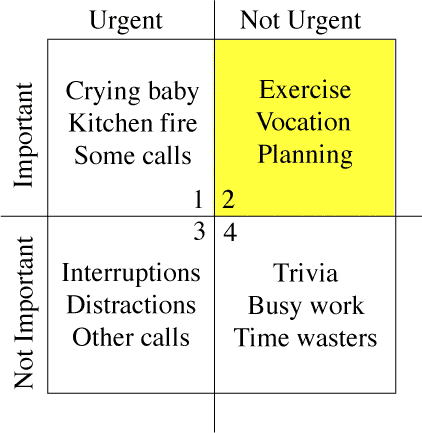
Next comes in the Eisenhower matrix. This principle divides all tasks into four categories related to how urgent and important they are (see graphic from Wikipedia). These categories now make up my GTD task lists. Every morning I select a limited number of tasks from the two "important" lists and put them in my daily planning. However, though GTD is a rather strict system and requires a certain level of self discipline, David Allen also recommends to use gut feeling to be productive. Hence, sometimes I feel more comfortable with doing an "urgent - not important" tasks, which is commonly regarded as self deception.

The problem with urgent and important tasks is that they often became urgent because of being unattended for so long. When I finally get to work on them I generally have to start from scratch - with limited time. But its very much easier (for me at least) to start things without pressure and continue occasionally. Hence, I always try to initially work approx one hour on tasks when they are still "not urgent". I call this "make things running" (MTR). In my daily planning the MTR schedules are usually located in the morning, when concentration is high and distractions are low. This "hour-of-power" principle is a common mangement technique, especially regarding tasks that have piled up for too long.

To organise this system on my computer I am tagging all incoming tasks according the Eisenhower categories. Emails are tagged using the respective function of my email client, files are tagged in the very useful file management tool "Nemo Documents" "tabbles" (Nemo unfortunately got discontinued, and tabbles evolved from version 2 to be way better than Nemo) and any thoughts, ideas and reminders are stored and tagged in Evernote.

I also tried the Pomodoro technique which slices tasks into several time blocks of twenty to thirty minutes, with five minutes intermissions. It fits easily into the strategy described here. However, I didn't find it useful for me.


Are PAH from coals ecotoxicologically relevant?

We just put out a paper in the journal Environmental Science & Technology about "Limited waterborne acute toxicity of native polycyclic aromatic compounds from coals of different types compared to their total hazard potential".

Wiebke Meyer of the University of Münster, Germany, has done part of her PhD thesis in our labs. She tested different types of coals for their toxic potential due to the contained natural PAH. Effects were recorded for extracts as well as the native coals samples using nematodes and zebrafish as test organisms.
Whereas the extracts - representing the overall hazardous potential - gave strong effectiveness in both test systems, no toxicity of the native samples was found, and thus the bioavailable contaminant fraction. Importantly, the results were independent of coal properties.

Find the publication here.